Kiosk or wall-mounted? Choosing an enclosure for an outdoor pump station
By Tristan Newton, Commercial Director · 12 June 2026 · 4 min read
The switchgear inside a pump control panel is the same whether it sits in a plant room or a field. What changes outdoors is everything around it: the box, the weather sealing, the heater, the light, the lock. Choose those well and the panel lasts twenty years. Choose badly and the first winter finds the condensation.
Here are the options, and how we decide between them.
Wall-mounted enclosure
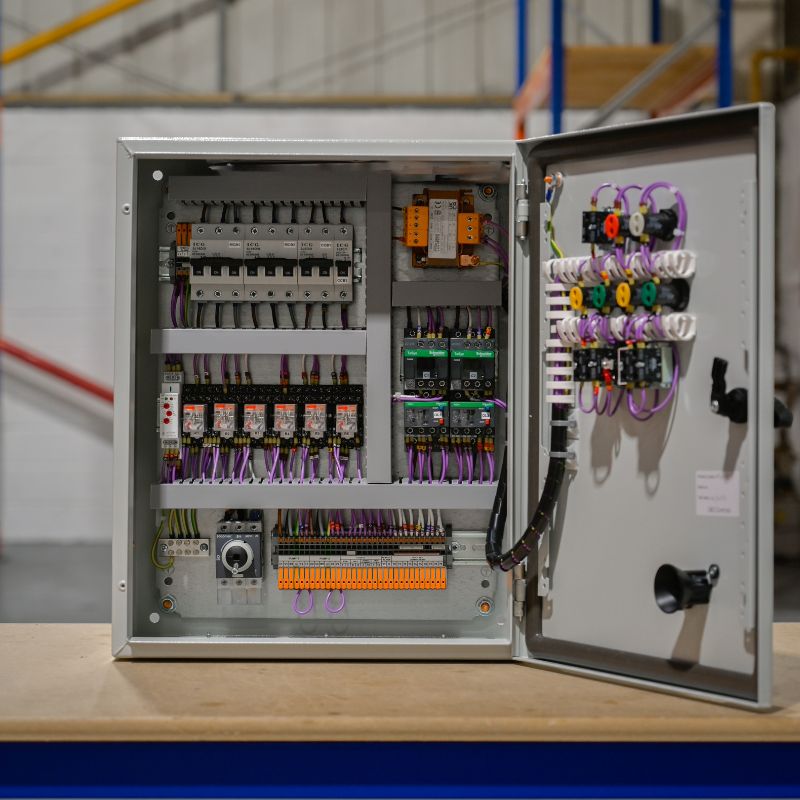
The standard Basix panel is a Schneider powder-coated mild steel wall-mounting enclosure, rated IP55 as standard, with IP66 as an option. It is right for:
- indoors: plant rooms, basements, garages, sheds;
- outdoors on a wall under some cover, or in a sheltered position, with the right rating.
For outdoor use on a wall, ask for the polyester option. A glass-reinforced polyester (GRP) enclosure does not rust, does not need painting and shrugs off a coastal atmosphere that would have a steel box weeping rust at the hinges within a couple of years. Mild steel vs poly-glazed enclosures covers the trade-offs; do control panel enclosures need to be metal? deals with the regulatory question.
Wall-mounted outdoors has one weakness: there is no wall at most pump stations. Which is why most of them end up in a kiosk.
GRP kiosk
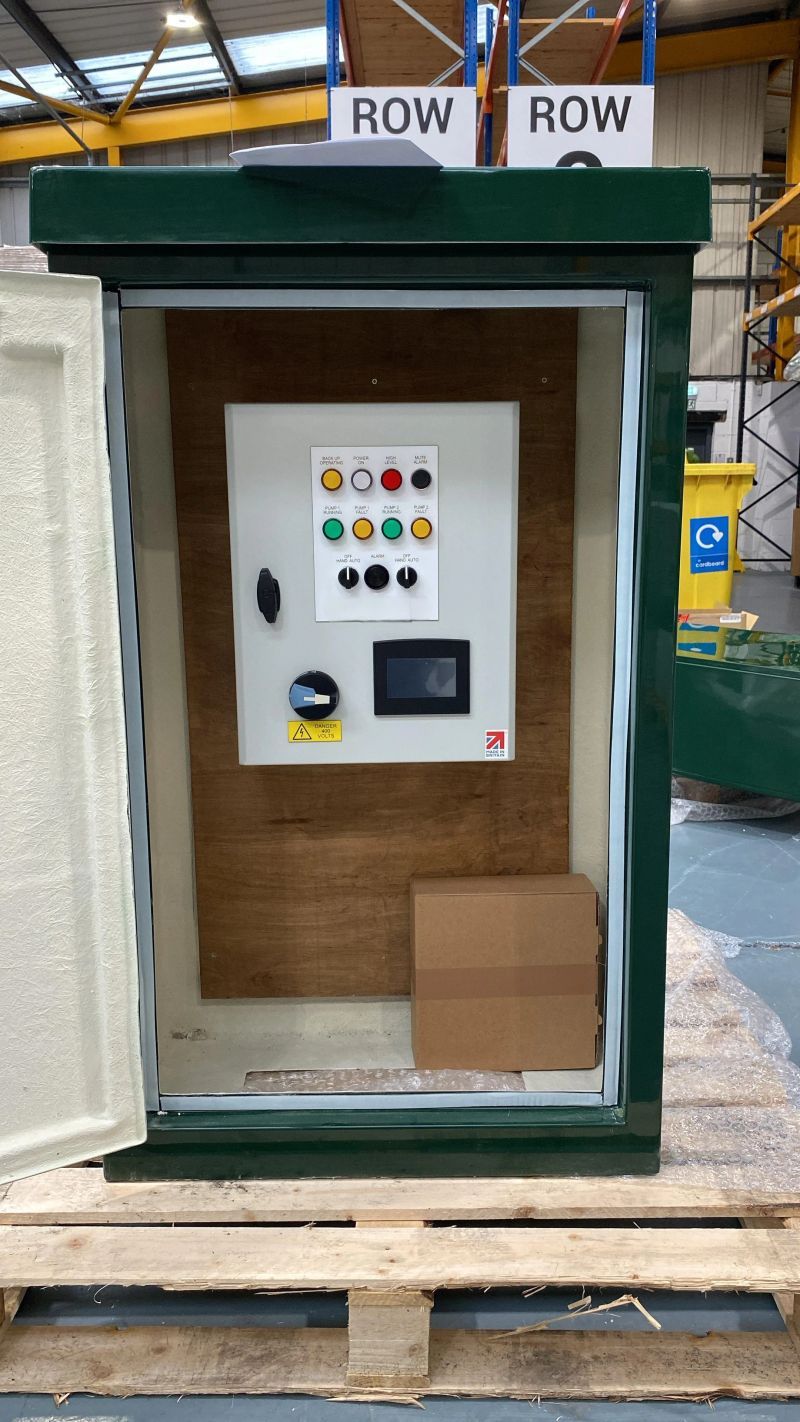
A kiosk is a free-standing glass-reinforced plastic housing on a plinth over the panel, with a door on the front. The panel lives inside it, the cables come up through the plinth from the chamber, and the door locks. It is the standard answer for a pump station in a field, a car park or a garden, and it is what the water companies require for adoptable stations.
We supply Basix and Telemetrix panels built into a kiosk, in two sizes:
- Single door, roughly 1250 high x 750 wide x 400 deep, for a single or twin pump panel;
- Double door, roughly 1260 x 1290 x 550, where there is a larger panel, a telemetry outstation or a generator changeover to house as well.
Green is the usual colour, to disappear into a verge; other colours to order.
What goes in a kiosk with the panel:
- A heater with a thermostat. The single most important extra. Outdoors, the air inside a closed box cools overnight and the moisture in it condenses on the coldest thing, which is the switchgear. A small heater keeps the inside a few degrees above the outside and the condensation never forms.
- A light. Because the callout is at 2am in January.
- A generator inlet, 32A, 63A or 125A, so a portable generator can run the station in a power cut. With the changeover arrangement, the panel takes care of the switch.
- An RCD socket for the engineer's tools.
- Mounting lugs to fix the kiosk to its plinth.
- A beacon on the roof for the high level alarm, with a guard where vandalism is a risk.
IP ratings: what you actually need
IP ratings describe how well the enclosure keeps out dust (first digit) and water (second). For control panels:
- IP55: dust-protected, and protected against water jets from any direction. The standard rating for our panels, and enough for an enclosure indoors or inside a kiosk.
- IP65: dust-tight, water jets.
- IP66: dust-tight, and protected against powerful jets. Ask for it where a panel is mounted outdoors on a wall without a kiosk, near a hose-down area, or anywhere the door will face the weather.
The kiosk itself takes the weather; the panel inside can be the standard IP55. A panel on an outside wall with no kiosk should be IP66.
A rating only holds while the door is shut and the glands are right. A gland plate with an unused hole in it is not IP anything.
Choosing
| Situation | Choose |
|---|---|
| Plant room or building | Standard steel wall-mounted, IP55 |
| Outside wall, sheltered | Polyester wall-mounted, IP66 |
| Outside wall, exposed or coastal | Polyester wall-mounted, IP66, heater |
| Free-standing anywhere | GRP kiosk, heater and light |
| Adoptable station | Kiosk to the water company's specification |
| Generator needed in a power cut | Kiosk with generator inlet |
Tell us where the panel is going and we will spec the enclosure with the quote. The options and their prices are itemised on the quotation; the Basix page lists what is available.
Frequently asked questions
Does a kiosk need a plinth?
Yes. The kiosk sits on a concrete or GRP plinth with the cable ducts coming up through it. The plinth keeps the base of the kiosk out of standing water and gives the mounting lugs something to fix to.
Is IP66 better than IP65?
Slightly: IP66 is tested against more powerful water jets. For an outdoor wall-mounted panel, IP66 is the one to ask for. Inside a kiosk, IP55 is fine.
Do I need a heater indoors?
Usually not in a heated building. In an unheated outbuilding or a basement that gets damp, yes. Condensation is about temperature swing and humidity, not just cold.
Can a kiosk hold two panels?
A double-door kiosk can house the pump panel alongside a telemetry outstation, a changeover switch or a second small panel. Tell us what has to go in and we will size it.
What about stainless steel?
Available at extra cost, for food, pharmaceutical or particularly aggressive environments. For most outdoor pump stations, polyester or a GRP kiosk does the same job for less.
Written by the engineers at G&G Controls, a UK control panel manufacturer in Stoke-on-Trent. For general guidance only; consult a qualified professional for advice on your own installation.
Up next
Should you gland both ends of SWA cable?
This question comes up constantly, usually framed as: "If I'm not using the armour as a CPC, do I really need to gland the load end?"